
the secret behind the Sitting and Rising from the Floor
As we live longer, staying healthy and independent in old age is more important than ever. While most people know that regular exercise and heart health matter, recent research suggests that our muscle strength, flexibility, and balance are just as crucial for predicting how long we might live. Many health assessments focus on factors like blood pressure and heart rate, but these don’t tell the whole story of how our bodies function in daily life.
A groundbreaking study sets out to answer a simple yet powerful question: Could your ability to sit down on the floor and stand back up without using your hands or knees for support provide insight into your overall health and longevity? The findings reveal that simple, everyday actions may have more to say about your future health than you ever expected.
What Is the Sitting-Rising Test (SRT)?
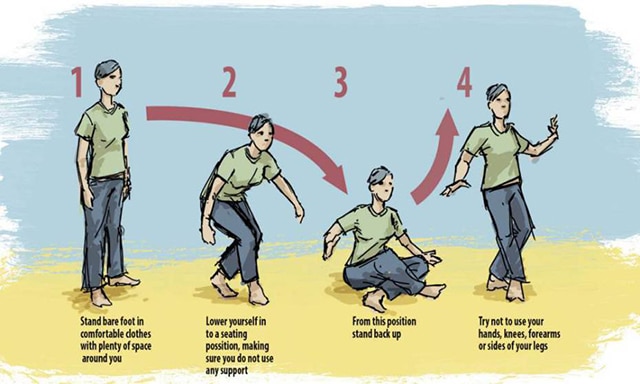
The sitting-rising test (SRT) is a quick and simple way to measure your muscle strength, flexibility, and balance. Here’s how it works:
- Stand upright on a flat surface.
- Sit down cross-legged on the floor, using as little support as possible.
- Then, stand back up, again using as little help as you can.
You start with a perfect score of 10. Each time you use a hand, knee, forearm, or lose your balance, you lose a point. The fewer supports you use, the higher your score.
The Study: Who Was Involved and What Did They Do?
Researchers recruited 2,002 adults from Brazil, all between the ages of 51 and 80. These participants were not professional athletes and did not have injuries or medical conditions that would make the test unsafe. Each person took the SRT at the start, and then researchers tracked their health and survival for more than six years.
To analyze the results, participants were grouped by their SRT scores:
- Group 1: Scores 0–3
- Group 2: Scores 3.5–5.5
- Group 3: Scores 6–7.5
- Group 4: Scores 8–10
Key Findings: Sitting and Rising Predicts Longevity
The results were striking:
- People with the lowest SRT scores were over five times more likely to die during the study compared to those with the highest scores, even after adjusting for age, sex, and body weight.
- Each point higher on the SRT lowered the risk of death by 21%.
- Almost no one who scored a perfect 10 died during the study period.
In other words, the easier it was for someone to sit and rise from the floor without help, the longer they tended to live.
Why Does the Sitting-Rising Test and Longevity Matter?
The SRT is more than just a physical fitness challenge. It taps into several aspects of health at once:
- Muscle strength (especially in the legs and core)
- Flexibility (to move smoothly and comfortably)
- Balance and coordination (to avoid losing your stability)
Losing these abilities increases the risk of falls and injuries, which are major health concerns as we age. The SRT is a quick and effective way to spot early signs of physical decline that might otherwise go unnoticed.
How the SRT Stands Out from Other Health Tests
Most fitness tests focus on how well your heart and lungs work. The SRT is unique because:
- It takes less than two minutes.
- It requires no special equipment.
- It provides a clear, easy-to-understand score.
- It is safe and practical for most adults, even seniors.
What Does This Mean for You?
If you can sit and rise from the floor without using your hands or knees, that’s a great sign of strong muscles, good balance, and flexibility. If you struggle, it might be time to add mobility-focused strength training to your routine. Improving these can help you stay independent and lower your risk of falls or injuries as you age.
Limitations to Keep in Mind
This study included mostly people from higher-income backgrounds in Brazil, so results might vary in other countries or communities. Also, the study did not track all possible influences on health, like day-to-day activity levels or specific causes of death. Still, the relationship between SRT performance and longevity was clear.
Try the Sitting-Rising Test and Longevity!
The sitting-rising test is a simple, safe way to check your fitness and even get a glimpse of your future health. Try it at home (make sure you’re safe and have support nearby if needed). If you find it difficult, talk to your doctor or a fitness professional about ways to improve your strength, balance, and flexibility.
Remember, your ability to move easily and independently might just be one of the best predictors of a long, healthy life! Learn more about me.
Reference
Brito LB, Ricardo DR, Araújo DS, Ramos PS, Myers J, Araújo CG. Ability to sit and rise from the floor as a predictor of all-cause mortality. Eur J Prev Cardiol. 2014 Jul;21(7):892-8. doi: 10.1177/2047487312471759. Epub 2012 Dec 13. PMID: 23242910.