
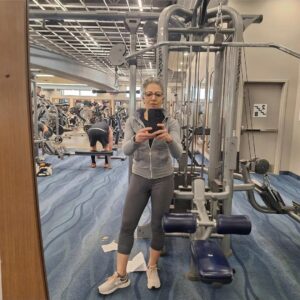
When I tell people I’m stronger at 65 than I was at 45, they often say, “Wow, you don’t look like 65, what is your secret?”
A large body of evidence shows that adults typically lose about 3% of muscle mass per decade after age 50, with strength declining even more rapidly, approximately 3% per year after age 70. But here’s what most people don’t know: this decline is largely preventable.
After three decades of studying exercise science and working with adults over 50, I’ve observed one mistake repeated more than any other. It’s not what you might expect. The biggest mistake isn’t doing too much—it’s doing too little.
The Mistake: Starting (and Staying) Too Light
Most people believe that once you hit 50, you need to “take it easy” with exercise. They avoid challenging themselves with heavier weights or higher intensity, fearing injury or thinking their bodies can’t handle it anymore.
This belief is not only wrong, but it’s actively harmful to your strength and independence.
What the Research Actually Shows
The Surprising Truth About Intensity
Mayer et al. (2011) conducted a study on progressive strength training after age 60. They found high-intensity resistance training significantly improved muscle strength, muscle mass, and functional performance, with very few adverse effects. Their findings highlight that progressive strength training in the elderly is efficent, even with higher intensity, to reduce sarcopenia, and to retain motor function.
Likewise, a more recent review explains that the abilities older adults lose most (strength, movement speed, and power) improve best when exercises are performed with challenging weights rather than very light ones. The authors note that while many programs still recommend light-to-moderate weights, training with heavier resistance is also recommended (Tøien et al. 2025).
The Numbers Don’t Lie
Research consistently shows that older adults experience remarkable strength gains from properly designed programs.
For example, a systematic review of 25 randomized controlled trials found that resistance training clearly improves strength in adults aged 65 and older. However, changes in muscle size are more minor and take longer. The authors (Borde et al. 2015) showed that training intensity and consistency over time matter, with better strength gains seen when people trained for longer periods and used moderate, but still challenging weights, rather than very light loads. Overall, the review suggests that many older adults could benefit more from better-designed strength programs than from overly cautious or inconsistent training.
Why This Matters for You
The Real Risk
Here’s the paradox: By trying to stay “safe” with light weights and low intensity, you’re actually putting yourself at greater risk.
Insufficient strength leads to:
- Difficulty with daily activities (climbing stairs, carrying groceries, getting up from chairs)
- Increased fall risk
- Loss of independence
- Accelerated muscle loss
Notably, the 2019 position statement from the National Strength and Conditioning Association (Maren et al. 2019) provides evidence-based recommendations for resistance training in older adults, highlighting that it is one of the most effective ways to preserve strength, mobility, and independence as they age. When programs are appropriately designed and progressed, strength training is safe and beneficial even for frail adults and those with chronic conditions, helping reduce functional decline and fall risk.
The Right Way to Start
Progressive, Not Passive
In fact, the goal of strength training after 50 is not to avoid effort; it’s to progress intelligently.
In simple words, progressive strength training means gradually increasing the challenge to your muscles so they continue to adapt and stay strong.
As a result, exercise that once felt hard becomes easier, and if the challenge does not increase, strength declines.
Therefore, progression does not mean lifting heavy weights recklessly. Instead, it means training at an intensity that feels challenging, where the final repetitions require effort while still using good form.
In short, muscles remain strong only when they are regularly challenged, not when workouts stay comfortable.
Safety Matters (But so does Adequate Challenge)
When to Be Cautious
Strength training temporarily increases heart rate and blood pressure. For this reason, training to complete muscular failure is not recommended for older adults with uncontrolled hypertension or cardiovascular disease.
However, when blood pressure is well controlled and exercise intensity is appropriately managed, resistance training is safe and strongly recommended (Paluch et al. 2024).
The Bottom Line: Progressive does not mean reckless
A common misunderstanding is that staying safe means lifting very light weights forever. In reality, insufficient challenge leads to physical decline, not protection. Progressive strength training prioritizes proper technique before increasing load, emphasizes gradual, intentional increases rather than sudden jumps, avoids training to the point of muscular failure—particularly for those at cardiovascular risk—and adjusts intensity based on individual health status and recovery. When applied thoughtfully, strength training can be both challenging and controlled, supporting strength, function, and long-term safety.
Remember: The goal isn’t to lift the heaviest weights in the gym. The goal is to lift weights heavy enough to trigger adaptation—to send your body the signal that it needs to maintain (and build) strength.
References
- Mayer F, Scharhag-Rosenberger F, Carlsohn A, Cassel M, Müller S, Scharhag J. The intensity and effects of strength training in the elderly. Dtsch Arztebl Int. 2011 May;108(21):359-64. doi: 10.3238/arztebl.2011.0359. Epub 2011 May 27. PMID: 21691559; PMCID: PMC3117172.
- Tøien T, Berg OK, Modena R, Brobakken MF, Wang E. Heavy Strength Training in Older Adults: Implications for Health, Disease and Physical Performance. J Cachexia Sarcopenia Muscle. 2025 Apr;16(2):e13804. doi: 10.1002/jcsm.13804. Erratum in: J Cachexia Sarcopenia Muscle. 2025 Aug;16(4):e70014. doi: 10.1002/jcsm.70014. PMID: 40241440; PMCID: PMC12003923.
- Borde R, Hortobágyi T, Granacher U. Dose-Response Relationships of Resistance Training in Healthy Old Adults: A Systematic Review and Meta-Analysis. Sports Med. 2015 Dec;45(12):1693-720. doi: 10.1007/s40279-015-0385-9. PMID: 26420238; PMCID: PMC4656698.
- Fragala, Maren S.; Cadore, Eduardo L.; Dorgo, Sandor; Izquierdo, Mikel; Kraemer, William J.; Peterson, Mark D.; Ryan, Eric D., Resistance Training for Older Adults: Position Statement From the National Strength and Conditioning Association. Journal of Strength and Conditioning Research 33(8):p 2019-2052, August 2019. | DOI: 10.1519/JSC.0000000000003230
- Paluch AE, Boyer WR, Franklin BA, Laddu D, Lobelo F, Lee DC, McDermott MM, Swift DL, Webel AR, Lane A; on behalf the American Heart Association Council on Lifestyle and Cardiometabolic Health; Council on Arteriosclerosis, Thrombosis and Vascular Biology; Council on Clinical Cardiology; Council on Cardiovascular and Stroke Nursing; Council on Epidemiology and Prevention; and Council on Peripheral Vascular Disease. Resistance Exercise Training in Individuals With and Without Cardiovascular Disease: 2023 Update: A Scientific Statement From the American Heart Association. Circulation. 2024 Jan 16;149(3):e217-e231. doi: 10.1161/CIR.0000000000001189. Epub 2023 Dec 7. PMID: 38059362; PMCID: PMC11209834.
Additional Reading: How to Build Muscle After 65: Shatter the Myth of Aging
Want personalized guidance on building strength safely after 50? Learn more about my Safe Strength After 50 program.